Heather Wright/The Herald
The St. Clair Region Conservation Authority says the aquifer which feeds private wells in the Dresden and Dawn-Euphemia areas is “highly vulnerable to any contamination” and it’s calling on the province to ensure there is water monitoring at the old Dresden dump.
That comes as two provincial leaders came to Dresden urging the community to continue the fight to force the provincial government to repeal the law which allows the Mississauga company to move ahead without a full Environmental Assessment.
The authority submitted its concerns to the Environmental Registry of Ontario in May. At the time, the province was introducing Bill 5 which, in part, reneged on a promise to the communities to force York1 Environmental to complete all the steps of a full Environmental Assessment before setting up its construction recycling centre and installing a 20-acre landfill.
The conservation authority submission was one of 2,162 received about the York1 EA in the 30-day public review. Only four submissions were in support of the project. The Herald asked for copies of those submissions. At press time, we had not received them.
The ERO says there were a number of concerns voiced including the need to look at alternatives for waste management in Ontario, concerns about York1’s plan to bring material in from all of Ontario instead of just Chatham-Kent as the original Environmental Compliance Approval states, how close the operation is to Dresden and “the proximity to the floodplain and the impact of severe weather” and “the potential impacts to water quality, specifically the underlying aquifer, Molly’s Creek and the Sydenham River.”
Ken Phillips, the general manager of the St. Clair Region Conservation Authority, says there is legislation which protects aquifers feeding municipal water systems. And the authority also watches the affects on private wells. Phillips says the former Dresden dump is in the area of a local aquifer.
“There is a potential for an aquifer in the area to be highly vulnerable to any contamination. So we would hope that the province would acknowledge this and make sure that when they’re planning the site, measures are taken to do a lot of monitoring, to do whatever mitigation measures they could do in the area,” Phillips says. That would include drilling specific wells with specific monitoring equipment, he says. He adds there are monitoring systems like this in the watershed and the company “wouldn’t have to reinvent the wheel.”
The Ministry of the Environment has voiced the same concern in the past. Documents show in March 2021, the ministry asked York1 to do a detailed hydrological study.
Bruce Harman, an engineer with the ministry voiced concerns about naturally occurring methane which could pose problems for up to 24 homeowners with wells in the region.
One couple, Dave and Shari Willson, have already dealt with methane issues at their home across the street from the site.
“The owner/operator should also ensure that future planned activity for the expanding landfill site will not alter the accumulation or flow migration of the naturally occurring gases at depth that may become a concern for the neighbour properties (water wells) located at least 500 meters from the property,” wrote Harman in 2021.
“The sampling and analysis of water from the domestic water wells located on residential properties, as a minimum, immediately adjacent to the southwestern landfill property boundary should occur as permitted by the water well owners, given the reported flow direction of the contact aquifer is from beneath the landfill property in a southwest direction toward these properties.”
Phillips told The Herald that neighbours of the site should be doing water well testing now so they will have a baseline if there is a problem in the future. Dresden CARED, a community group fighting the York1 plans, was busy collecting water samples in the area July 7.
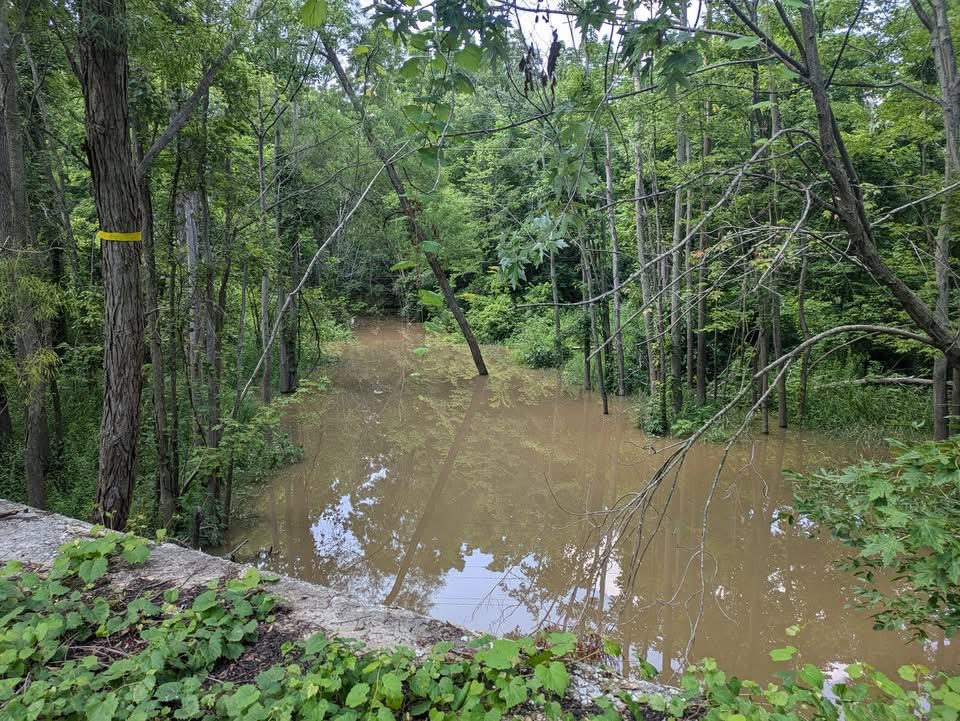
The conservation authority is also concerned about the potential for runoff entering Molly’s Creek, a local drain and eventually the Sydenham River. Phillips says the company’s plans should include plantings and buffer zones to stop runoff going into the natural water courses.
“We would hope they take those steps in this case, because there would be impacts if there’s a major flood in the area because a portion of the York1 site does lie within the Flood Hazard Area,” said Phillips.
“You’re talking about something flowing directly into, ultimately, the Sydenham River. So, we would hope that they work with us and other agencies and municipalities, Chatham-Kent specifically, to make sure that steps are taken to ensure that any potential hazards are dealt with at the source rather than dealing with further downstream.”
Phillips added it would be unlikely a new landfill project or even a private home would be built in a flood plan in the area.
The conservation authority’s concerns, like the other 2,157, were read by ERO officials. It still approved the province request to develop the York1 project without a full assessment.

 The Herald serving Thamesville, Dresden and Bothwell